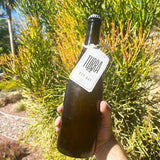
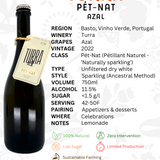
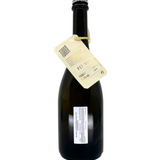
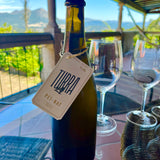
Turra Pét-Nat Azal White 2025
Fresh, lively and wonderfully unconventional, Turra Pét-Nat Azal is a naturally sparkling white wine that brings one of Portugal's oldest winemaking traditions back to life. Made from 100% Azal, an indigenous grape celebrated for its remarkable acidity, this delightfully expressive Pét-Nat combines crisp green apple, fragrant quince, delicate tropical fruit and soft, refreshing bubbles with a wonderfully vibrant finish.
From the beautiful mountainous landscapes of Basto, in Portugal's Vinho Verde region, Turra Pét-Nat Azal is much more than another fashionable natural sparkling wine.
It's a celebration of the region's history.
Long before Vinho Verde became internationally famous for its light, refreshing white wines, local winemakers were producing wines using techniques that allowed fermentation to continue naturally in the bottle.
These wines could develop a gentle effervescence, giving them the lively, refreshing character that became closely associated with the region.
And one of the grapes at the heart of this tradition was Azal.
Once much more widely planted throughout Vinho Verde, Azal is a traditional Portuguese white variety particularly valued for its naturally high acidity.
Today, it often plays a supporting role in white blends, but Turra has chosen to give it centre stage.
Made from 100% Azal, this wine is produced using the ancestral method of sparkling winemaking, commonly known as Pét-Nat.
Rather than completing fermentation before bottling and then beginning a separate fermentation, the wine is bottled while its first fermentation is still underway.
As fermentation finishes inside the sealed bottle, naturally produced carbon dioxide becomes trapped in the wine, creating its bubbles.
The result is a sparkling wine with a wonderfully spontaneous personality.
Turra's approach also embraces the more rustic side of traditional Pét-Nat production, with no filtration and naturally occurring sediment remaining in the bottle.
In the glass, expect lively aromas of fresh green apple, ripe quince, subtle banana, delicate tropical fruit and light floral notes.
On the palate, it's wonderfully refreshing, with vibrant acidity, expressive fruit and a gentle, soft mousse.
At 11.5% ABV, it's a beautifully lively wine that feels equally appropriate as an aperitif or alongside a leisurely meal.
And there's something particularly special about its connection to the past.
Turra created this wine to bring a historic expression of Vinho Verde into the modern world.
What makes Azal so special?
Azal is one of northern Portugal's traditional indigenous white grape varieties, particularly associated with the Vinho Verde region.
Although it doesn't have the international recognition of Alvarinho or Loureiro, Azal has played an important role in the region's winemaking history.
The grape is especially valued for its naturally high acidity, which gives wines a crisp, lively and refreshing character.
Typical aromas and flavours include green apple, lemon, lime, citrus peel and delicate orchard fruit.
In some wines, it can also contribute subtle floral or herbal characteristics.
Azal generally ripens relatively late, which can be particularly important in the mild, Atlantic-influenced climate of northern Portugal.
Its naturally high acidity means that even when the grapes reach suitable ripeness, the resulting wines can retain remarkable freshness.
And this makes Azal an excellent candidate for sparkling wine.
Acidity is one of the most important characteristics in a well-balanced sparkling wine.
The bubbles create a lively sensation, but acidity provides the underlying freshness that keeps the wine crisp and refreshing.
In Turra's Pét-Nat, Azal's naturally vibrant character works beautifully with the soft, delicate effervescence.
It's a wonderful opportunity to discover a grape that deserves far more attention.
Why was Azal once so important in Vinho Verde?
One of the most fascinating aspects of Turra Pét-Nat is the history of the grape itself.
Azal was once considerably more prominent in the vineyards of Vinho Verde than it is today.
At the beginning of the twentieth century, it was among the region's most important traditional white varieties.
Over time, the vineyard landscape changed.
Different grape varieties gained prominence as viticulture developed, consumer preferences evolved and producers began focusing more heavily on particular regional specialities.
Alvarinho became internationally celebrated for its aromatic intensity and structure.
Loureiro developed a strong reputation for its fragrant floral character.
And Azal increasingly became valued as a blending grape, particularly in the Basto subregion.
But its relative lack of fame doesn't mean it lacks quality.
Quite the opposite.
Azal's naturally high acidity gives it a distinctive character that can be particularly valuable in sparkling wines.
Turra's decision to produce a single-varietal Azal Pét-Nat is therefore especially interesting.
Rather than simply using Azal to add freshness to a blend, the producer allows the grape to express its own personality.
And by combining it with an ancestral sparkling method, Turra creates a wine that reconnects with an older chapter of Vinho Verde's history.
What exactly is Pét-Nat?
The term Pét-Nat is short for pétillant naturel, a French expression meaning “naturally sparkling”.
And although Pét-Nat has become increasingly fashionable in recent years, the technique behind it is centuries old.
Pét-Nat is generally made using the ancestral method, one of the oldest approaches to producing sparkling wine.
The process begins much like ordinary winemaking.
Freshly harvested grapes are pressed, and the juice begins fermenting as yeast converts natural grape sugars into alcohol and carbon dioxide.
But here's where things become interesting.
Before fermentation has finished, the wine is bottled.
The remaining fermentation then continues inside the sealed bottle.
As the yeast converts the remaining sugars into alcohol, it also produces carbon dioxide.
Because the bottle is sealed, that carbon dioxide becomes dissolved in the wine.
And when the bottle is opened, it creates the bubbles.
The result is a naturally sparkling wine produced through a single continuous fermentation.
It's a wonderfully direct approach to sparkling winemaking.
And because the wine finishes fermenting in the bottle, the final result can retain more of the character of its fermentation process.
Turra Pét-Nat Azal embraces this traditional technique, creating a wine that feels lively, expressive and beautifully individual.
How is Pét-Nat different from Champagne?
Although both Pét-Nat and Champagne contain naturally produced bubbles, they're made using different methods.
Champagne is produced using the traditional method, which involves two separate fermentations.
First, a still base wine is made.
Then yeast and sugar are added before the wine is bottled for a second fermentation.
This second fermentation produces the carbon dioxide responsible for Champagne's bubbles.
After ageing, the sediment is generally collected and removed through a process called disgorgement.
Pét-Nat is different.
The wine is bottled before its first fermentation has finished, allowing that same fermentation to continue in the bottle.
There's no need to begin a separate second fermentation.
And many Pét-Nats are bottled without filtration or disgorgement, meaning the natural yeast sediment remains.
This can give them a slightly cloudy appearance and a more rustic personality.
Pét-Nats also frequently have softer, less persistent bubbles than traditional-method sparkling wines, although the exact pressure varies between producers.
Neither method is inherently better.
They simply create different styles.
Champagne often emphasises precision, extended maturation and complex ageing characteristics.
Pét-Nat frequently celebrates freshness, spontaneity and a more direct expression of the grapes.
Turra's Azal is a particularly enjoyable example of the latter.
Why is Turra Pét-Nat cloudy?
One of the first things you might notice about Turra Pét-Nat Azal is that it doesn't necessarily look like a perfectly clear, conventional sparkling wine.
And that's entirely intentional.
Turra produces this wine without filtration, allowing naturally occurring sediment to remain in the bottle.
During fermentation, yeast converts grape sugars into alcohol and carbon dioxide.
Once fermentation is complete, the yeast cells gradually become inactive and settle.
These spent yeast cells form part of the sediment known as lees.
In many conventional sparkling wines, this sediment is removed before the bottle reaches the customer.
But in an undisgorged Pét-Nat, it remains.
This can give the wine a slightly hazy or cloudy appearance.
And because the sediment can settle at the bottom of the bottle, the appearance may change depending on how the wine is poured.
A cloudy Pét-Nat isn't automatically faulty.
In this style, sediment can be a normal consequence of the production method.
Some people prefer to pour gently, leaving most of the sediment in the bottle.
Others enjoy gently incorporating a little of it for a more textured, rustic experience.
Either approach can be enjoyable.
The important thing is understanding that the cloudiness is part of the wine's character rather than necessarily a sign that something has gone wrong.
Why does Pét-Nat have such gentle bubbles?
One of the most appealing characteristics of many Pét-Nats is their soft, delicate effervescence.
Rather than the powerful, persistent bubbles of some traditional-method sparkling wines, Pét-Nat can offer a gentler, more relaxed sparkling sensation.
But why?
The amount of carbon dioxide in a sparkling wine depends on several factors, including how much fermentable sugar remains when the wine is sealed.
In Pét-Nat production, the winemaker must carefully judge when to bottle the wine.
If too little fermentation remains, the wine may develop insufficient pressure.
If too much remains, the pressure can become excessive.
The timing is therefore an important part of the winemaker's skill.
Turra's producer tasting notes describe a soft bubble, which complements Azal's naturally vibrant acidity.
And that combination is particularly appealing.
The gentle effervescence enhances the wine's refreshing character without overwhelming its fruit.
It's a sparkling wine that feels lively and expressive rather than aggressively fizzy.
Why does this wine smell of apple, quince and banana?
One of the most interesting aspects of Turra Pét-Nat Azal is its aromatic profile.
Alongside fresh apple and quince, the producer describes subtle banana and tropical-fruit characteristics.
And there's some fascinating chemistry behind those aromas.
Wine contains hundreds of aromatic compounds, many of which develop during fermentation.
Some aromas originate from compounds naturally present in the grapes.
Others are created by yeast as it converts grape sugars into alcohol.
One important group is called esters.
Esters can contribute fruity aromas reminiscent of banana, pear, apple and other fruits.
For example, isoamyl acetate is particularly associated with banana-like aromas.
The amount of these compounds produced depends on factors such as yeast activity, fermentation temperature, grape composition and winemaking conditions.
And here's the important thing.
These fruit aromas don't mean that apple, quince, banana or tropical fruit have been added to the wine.
They're naturally occurring sensory impressions created through the interaction of grapes and fermentation.
For Turra Pét-Nat, these fermentation-derived aromas contribute to its wonderfully expressive personality.
It's a lovely example of how the winemaking process can create flavours that go far beyond the grape itself.
What makes Basto different from the rest of Vinho Verde?
Vinho Verde is often associated with lush coastal landscapes, Atlantic breezes and fresh, aromatic white wines.
But the region is geographically diverse.
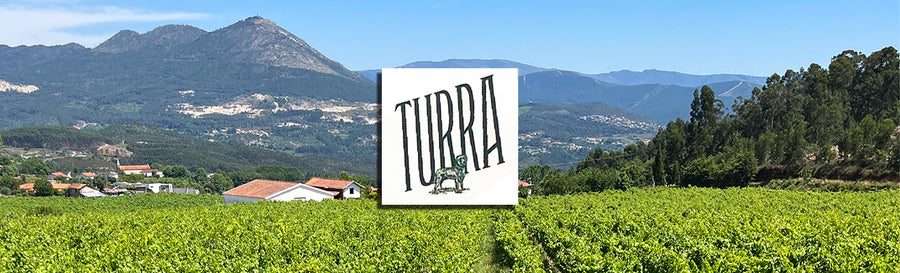
And Basto, where Turra's vineyards are located, is a particularly fascinating example.
Situated farther inland, Basto is characterised by hills, valleys and mountainous terrain.
The landscape around Mondim de Basto is particularly dramatic, overlooked by Monte Farinha, the mountain crowned by the Sanctuary of Nossa Senhora da Graça.
Unlike the more directly Atlantic-influenced coastal parts of Vinho Verde, Basto has a somewhat more sheltered climate.
Its inland position and surrounding mountains can create warmer summer conditions and greater temperature variation.
These differences influence grape ripening.
Warmer growing conditions may encourage the development of riper fruit flavours.
At the same time, vineyard elevation and cooler nights can help preserve freshness.
And Azal is particularly well suited to this environment.
The grape is an important part of Basto's traditional viticultural identity.
Its naturally high acidity makes it valuable in blends and particularly interesting for sparkling wines.
Turra Pét-Nat is a wonderful example of how a local grape and a traditional winemaking method can come together to create something distinctive.
What is the connection between Pét-Nat and traditional Vinho Verde?
Although Pét-Nat is a French term, the idea of naturally sparkling wine has an important connection to Vinho Verde's history.
Historically, some wines from the region retained carbon dioxide from fermentation.
This created the delicate spritz known in Portuguese as agulha, meaning needle.
The name refers to the subtle prickling sensation the bubbles create on the tongue.
Before modern temperature control and fermentation management became widespread, wines could retain dissolved carbon dioxide or continue fermenting after storage or bottling.
And that contributed to Vinho Verde's reputation for youthful, lively wines.
However, there's an important distinction.
A traditional lightly spritzy Vinho Verde isn't necessarily the same thing as a modern Pét-Nat.
A gentle spritz can be retained or introduced in different ways.
Pét-Nat specifically involves bottling the wine before its first fermentation has finished.
Turra deliberately uses this ancestral method to reconnect with the region's historic winemaking character.
And by choosing Azal, a grape once much more prominent in Vinho Verde, the producer reinforces that connection.
It's a modern wine with a wonderfully old-fashioned soul.
What does “no added sulphites” actually mean?
Turra's original Pét-Nat technical information describes a winemaking approach without added sulphites.
And that's an interesting distinction.
Sulphur dioxide is widely used in winemaking because it can help protect wine from oxidation and unwanted microbial activity.
It may be added at different stages of production depending on the winemaker's approach.
But sulphites can also occur naturally during fermentation.
That means a wine made without added sulphites isn't necessarily completely sulphite-free.
Yeast can produce small amounts of sulphur compounds during fermentation, and naturally occurring sulphites may remain in the finished wine.
This is why a wine can be described as having no added sulphites while still requiring a sulphite declaration on its label.
Turra's approach reflects a preference for relatively low-intervention winemaking.
But low intervention doesn't mean that no skill or care is involved.
In fact, producing stable, enjoyable wines with fewer additions can require particularly careful attention to grape quality, hygiene, fermentation and bottling.
It's another fascinating aspect of the producer's philosophy.
Why should Pét-Nat be opened carefully?
Pét-Nat can be a little more unpredictable than conventional sparkling wine.
And that's part of its charm.
Because fermentation finishes inside the bottle, natural sediment may remain, and the amount of dissolved carbon dioxide can vary.
Some bottles open quietly.
Others can be rather enthusiastic.
The best approach is to chill the wine thoroughly before opening.
Cold wine generally retains dissolved carbon dioxide more readily than warm wine, helping reduce the risk of excessive foaming.
Keep the bottle upright for several hours beforehand if you'd prefer the sediment to settle.
When opening, point the bottle away from yourself and other people, and release the closure slowly and carefully.
It's also a good idea to have a glass ready.
And avoid shaking the bottle.
If you prefer a clearer wine, pour gently and leave the final sediment-rich portion behind.
If you enjoy the more rustic side of Pét-Nat, you can incorporate a little of the sediment.
Either way, it's best enjoyed fresh and well chilled.
What's the story behind the name Turra?
Despite the seriousness of its winemaking, Turra has a wonderfully playful origin.
The project is named after the family's dog.
The Portuguese word turra can refer to a bump or headbutt.
And according to the producers, their enthusiastic but rather clumsy dog had a habit of bumping his head into things.
The name became a tribute to a much-loved companion.
It's an endearing story that reflects the personality behind the wines.
Rather than treating winemaking as something overly formal, Turra celebrates friendship, companionship and a shared enthusiasm for creating something distinctive.
And there's something particularly appropriate about that philosophy for a Pét-Nat.
A playful name, an unconventional winemaking method and a wine that doesn't take itself too seriously.
It's exactly the sort of bottle that makes discovering small Portuguese producers so enjoyable.
About Turra
Turra is an independent Portuguese wine project based in the beautiful Basto subregion of Vinho Verde, in northern Portugal.
Created by friends Bruno Mota and Nuno Andrade, with the involvement of winemaker Constantino Ramos, the project combines a strong connection to the region with a desire to produce distinctive, expressive wines.
The vineyards are situated around Mondim de Basto, surrounded by the dramatic mountainous landscape of northern Portugal.
Overlooking the area is Monte Farinha, one of the region's most recognisable landmarks.
Turra works with traditional Portuguese grape varieties, exploring both familiar and unconventional approaches to winemaking.
Its range includes fresh white wines, expressive Vinhão reds and distinctive Pét-Nats, alongside more complex expressions such as Craft Barrica Alvarinho.
And while the project respects the region's winemaking traditions, it isn't afraid to experiment.
Turra Pét-Nat Azal is a particularly lovely example.
By choosing a grape that was once much more prominent in Vinho Verde and combining it with the ancestral method of sparkling winemaking, Turra has created a wine that celebrates both the region's past and its future.
The result is fresh, expressive, slightly unconventional and wonderfully enjoyable.
One historic Portuguese grape, a centuries-old sparkling method and the mountainous landscape of Basto — Turra Pét-Nat Azal is a delicious reminder that sometimes the most exciting wines are the ones that reconnect us with the past.
Aroma: Green Apple · Quince · Subtle Banana · Delicate Tropical Fruit · Light Floral Notes
Palate: Dry · Crisp Orchard Fruit · Vibrant Acidity · Soft Natural Bubbles · Fresh, Fruity Finish
Pair with: Fresh Oysters · Grilled Shrimp · Sushi · Fried Calamari · Bolinhos de Bacalhau · Peixinhos da Horta · Fresh Goat Cheese · Portuguese Petiscos · Salted Almonds
Serving Temperature: 8–10°C / 46–50°F