Herdade da Lisboa 'Convés' Red Blend 2023
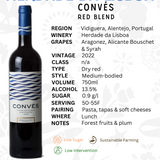
A beautifully generous and wonderfully smooth red wine from Portugal's sun-drenched Alentejo region, bursting with ripe blackberries, juicy red berries and delicate spice. Combining the Portuguese classic Aragonez with Alicante Bouschet and Syrah, this deliciously approachable blend captures the warmth of southern Portugal while retaining the freshness and balance that make Vidigueira's wines so special.
Herdade da Lisboa Convés Red Blend comes from Vidigueira, in southern Portugal's Alentejo wine region, where rolling vineyards, ancient olive groves and golden landscapes stretch towards the horizon.
Made from Aragonez, Alicante Bouschet and Syrah, this expressive red brings together three grape varieties with very different backgrounds, each contributing something distinctive to the finished wine.
Aragonez provides juicy red fruit and structure, Alicante Bouschet contributes deep colour and concentrated dark berries, while Syrah brings aromatic complexity and a touch of spice.
In the glass, expect a beautiful, concentrated ruby-red colour with inviting aromas of ripe blackberries, red cherries, wild berries and subtle spice.
On the palate, it's dry, rounded and beautifully balanced, with generous fruit, smooth tannins and a lovely freshness that keeps the wine lively rather than heavy. The finish is soft, harmonious and pleasantly persistent.
At 13.5% ABV, this is a wonderfully versatile Alentejo red, equally enjoyable with a hearty Portuguese dinner, grilled meats, pizza or a relaxed evening with friends.
And there's something particularly interesting about where it's made.
Although Alentejo is one of Portugal's warmest wine regions, Vidigueira benefits from a distinctive local climate that helps preserve freshness in its wines.
Meet the grapes behind the blend
Three grapes, three different origins and three distinctive personalities come together to create this beautifully balanced Alentejo red.
Aragonez – The Portuguese Classic
Aragonez is one of Portugal's most important red grape varieties, particularly associated with Alentejo.
But here's an interesting connection: Aragonez is the same grape as Tempranillo, the famous Spanish variety behind many of Rioja and Ribera del Duero's celebrated red wines.
In northern Portugal, particularly the Douro and Dão regions, it's more commonly known as Tinta Roriz.
The grape is prized for its versatility, producing everything from approachable, fruit-forward reds to structured wines capable of extended ageing.
Typical characteristics include red cherry, strawberry, plum and subtle spice, often accompanied by balanced tannins.
In the warm climate of Alentejo, Aragonez can develop beautifully ripe fruit while retaining enough structure to make it an excellent blending partner.
In Convés, it contributes juicy red fruit, balance and an approachable character.
Alicante Bouschet – The Grape with Red Flesh
Alicante Bouschet is one of the most fascinating red grapes grown in Portugal.
Unlike most red wine grapes, which have dark skins but clear or nearly colourless flesh, Alicante Bouschet has red-pigmented flesh as well as red skins.
This makes it a member of a relatively small group of grapes known as teinturiers, or red-fleshed varieties.
And here's something else that makes it particularly interesting.
Alicante Bouschet isn't originally Portuguese.
It was created in France in 1866 by grape breeder Henri Bouschet, who crossed Petit Bouschet with Grenache.
Although it originated in France, the grape found a particularly successful home in Alentejo, where its ability to produce deeply coloured, concentrated wines made it highly valued.
Today, it's become so closely associated with Alentejo that many people think of it as one of the region's signature grapes.
Typical characteristics include blackberry, black plum, dark cherry and subtle earthy notes, often accompanied by generous tannins and impressive colour.
In Convés, Alicante Bouschet contributes richness, depth and that beautiful concentrated ruby colour.
Syrah – The Spice and Complexity
Syrah is one of the world's most celebrated red grape varieties, originally associated with France's northern Rhône Valley.
It's particularly famous for producing deeply coloured wines with dark fruit, spice and sometimes distinctive black pepper aromas.
Typical characteristics include blackberry, blueberry, plum, violet and black pepper, often accompanied by subtle herbal or savoury notes.
Although Syrah isn't indigenous to Portugal, it has adapted particularly well to several Portuguese wine regions, including Alentejo.
The region's warm summers allow Syrah to develop ripe, generous fruit, while careful vineyard management can help preserve freshness and balance.
In Convés, Syrah contributes aromatic complexity, spice and a lovely sense of depth.
Together, Aragonez, Alicante Bouschet and Syrah create a wine that combines ripe fruit, generous colour, gentle spice and beautifully rounded tannins.
Why is Alicante Bouschet so important in Alentejo?
Here's one of the most interesting stories in Portuguese wine.
One of Alentejo's most recognisable red grapes isn't actually Portuguese.
Alicante Bouschet was developed in France during the 19th century, but over time it became particularly successful in southern Portugal.
Alentejo's warm, dry climate allows the variety to ripen well, developing the concentrated fruit and deep colour for which it's celebrated.
And unlike most red grapes, Alicante Bouschet is a teinturier, meaning its flesh contains red pigments.
Normally, red wine gets much of its colour from the skins during fermentation.
But Alicante Bouschet can contribute colour from both the skins and the juice, making it especially valuable in blends.
It's also capable of producing wines with impressive tannin structure and ageing potential.
Today, Alicante Bouschet is regarded as one of Alentejo's signature red varieties, despite its French origins.
In Convés, it works alongside Aragonez and Syrah to produce a wine that is beautifully coloured, fruit-forward and wonderfully balanced.
It's a lovely example of how grape varieties can find a second home in a completely different country and become an important part of that region's wine identity.
What makes Vidigueira different from the rest of Alentejo?
Alentejo is one of Portugal's largest and warmest wine regions, famous for its vast plains, rolling hills, cork oak forests and generous red wines.
But not all parts of Alentejo experience exactly the same climate.
Vidigueira, in southern Alentejo, has a particularly interesting microclimate influenced by the nearby Serra do Mendro.
This mountain range helps shape local airflow and temperature patterns, contributing to the contrast between warm days and cooler nights.
These daily temperature differences, known as diurnal temperature variation, can be particularly important for grape growing.
During the day, warmth encourages grapes to ripen and develop flavour.
At night, cooler temperatures can slow the loss of acidity, helping preserve freshness as the grapes mature.
This balance is especially valuable in a warm region such as Alentejo, where grapes can otherwise develop very ripe fruit and high sugar levels.
Herdade da Lisboa's vineyards also include clay-schist soils, which influence drainage, water availability and the growing conditions experienced by the vines.
The result is a fascinating combination of ripe southern Portuguese fruit and refreshing balance.
And it's one of the reasons we were so impressed when we first tasted the wines from Herdade da Lisboa.
Despite the warmth of Alentejo, they had a freshness we hadn't expected.
What does Convés mean?
The name Convés means "deck of a boat" in Portuguese.
And it's a particularly fitting name for a wine with a connection to one of Portugal's most famous maritime explorers.
In 1498, Vasco da Gama completed the first recorded voyage from Europe to India by sailing around the southern tip of Africa, opening a direct maritime route between Europe and Asia.
His voyage became one of the defining events of Portugal's Age of Discovery.
In recognition of his achievements, Vasco da Gama was later granted the title Count of Vidigueira.
His connection to the area forms part of the historical inspiration behind Herdade da Lisboa's Convés range.
The name pays tribute to Portugal's maritime heritage and the region's association with one of its most famous navigators.
It's a lovely reminder that Portuguese wine labels often tell stories extending far beyond the vineyard, connecting the country's wines with its history, culture and traditions.
Why does Convés taste so smooth?
One of the most appealing things about Convés is its rounded, approachable character.
But what actually makes a red wine feel smooth?
Much of the answer lies in tannins, naturally occurring compounds found in grape skins, seeds and stems.
Tannins create the drying sensation you sometimes notice when drinking red wine, rather like the feeling of strong black tea.
Different grape varieties naturally contribute different tannin structures, and the way a wine is made can influence how those tannins are extracted.
Ripeness is also important.
As grapes mature, their tannins generally become less aggressively green or astringent, although the relationship between ripeness and texture is complex.
In a warm region such as Alentejo, grapes can develop generous fruit and ripe tannin characteristics.
Blending can then help create a more harmonious wine.
In Convés, Aragonez contributes juicy fruit, Alicante Bouschet adds concentration and Syrah provides aromatic complexity.
The result is a red wine with a lovely combination of rich fruit, rounded tannins and balanced freshness.
It's an excellent introduction to Portuguese reds for customers who enjoy smooth, generous wines without excessive heaviness.
About Herdade da Lisboa
Herdade da Lisboa is a family-owned wine estate in Selmes, near Vidigueira, in Portugal's Alentejo region.
Although the property has a winemaking history stretching back to the 18th century, its modern chapter began in 2011, when it was acquired by João Cardoso and his two sons.
The family has invested in developing the estate while preserving its agricultural heritage, combining modern winemaking with traditional Alentejo practices.
The property encompasses approximately 350 hectares, including around 100 hectares of vineyards and extensive olive groves.
Its vineyards are planted with both Portuguese and international grape varieties, reflecting the diversity of modern Alentejo winemaking.
Alongside Aragonez and Alicante Bouschet, the estate grows varieties such as Touriga Nacional, Trincadeira, Syrah and Cabernet Sauvignon.
The winery also produces olive oil, another important part of Alentejo's agricultural traditions.
Sustainability plays an important role in the estate's approach, with vineyard practices designed to manage water, energy and other resources responsibly.
The property uses measures such as natural ground cover, mechanical weed control, solar energy and soil-moisture monitoring.
During our visit, we met winemaker Ricardo and commercial director Alexandre, and were particularly impressed by the freshness they achieved in a region famous for its warm climate.
We were also treated to migas, a traditional Alentejo dish made with bread, garlic and olive oil, which offered a delicious introduction to the region's food culture.
For us, Herdade da Lisboa represents one of the things we love most about Portuguese wine: family-run producers combining local history, traditional grapes and thoughtful winemaking to create wines with genuine character.
And Convés Red Blend is a particularly lovely introduction to their approach, offering the generous fruit of Alentejo alongside the freshness and balance that make these wines so enjoyable.
Aroma: Blackberry · Red Cherry · Wild Berries · Ripe Plum · Delicate Spice
Palate: Dry · Medium-bodied · Juicy Dark Fruit · Smooth, Rounded Tannins · Balanced Acidity · Harmonious Finish
Pair with: Grilled Steak · Roast Pork · Lamb Chops · Portuguese Migas · Chouriço · Pizza · Beef Stew · Mushroom Risotto · Aged Cheeses
Serving Temperature: 16–18°C / 61–64°F